


It’s been a big year at SOLARCYCLE, and one that underscores why solar recycling matters now more than ever.
Over the past year, our team has made significant progress scaling the infrastructure needed to responsibly manage the next phase of the solar industry’s growth. We deployed next-generation de-framing and de-glassing tools that operate at more than double the throughput of our first-generation lines. We launched recycling operations at our new facility in Cedartown, Georgia, where we are now processing thousands of panels per week and scaling toward one million panels annually by the end of 2026.
We also expanded our national footprint to five sites capable of processing more than two million panels per year, secured an exclusive partnership to improve metals refining purity while lowering costs, began accepting electronic balance-of-system (eBOS) materials such as inverters and transformers, and achieved customer commitments for more than 80% of capacity at our future solar glass factory. Along the way, we developed the first-ever solar module made with 50% recycled glass from end-of-life panels.
All of this, by the way, while diverting hundreds of thousands of solar panels from landfills and keeping valuable materials in circulation. (Keep an eye out for our impact report in the new year.)
This matters because solar energy continues to be the fastest-growing and lowest-cost source of new power. Earlier this month, SEIA reported that solar and storage accounted for 85% of new power added to the grid this year, even in the face of federal blowback.
As solar deployment accelerates, so does the need for a scalable, cost-effective recycling solution. By our estimates, the U.S. will be ready to retire anywhere between 10 to 25 million solar panels per year by 2030.
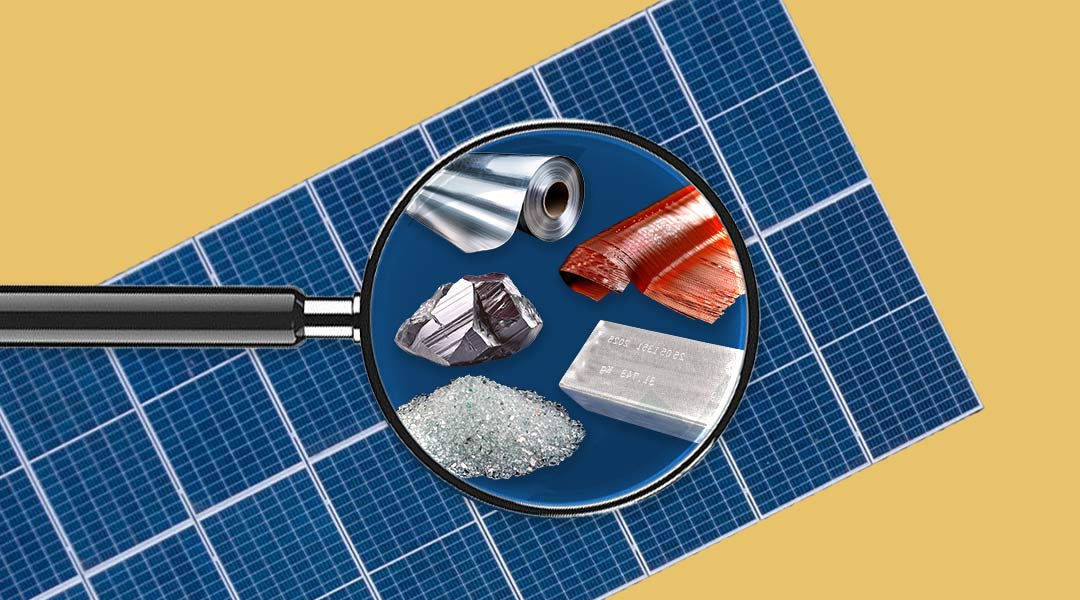
We don’t view retired solar panels as trash; we see them as resource-rich assets. Each one contains critical materials like aluminum, copper, silver, and glass: the very materials needed to build the factories, data centers, and energy infrastructure of the future.
Let’s do some back of the napkin math for silver as an example.
If we take the 260 gigawatts of solar capacity in the U.S., divided by an average sized 350-watt solar panel, we could conservatively assume that there’s around 750 million solar panels installed domestically today.
If you ask Google, you’ll find some sources that say there are 20 grams of silver in a single panel. We’ve been handling materials in solar panels for years and think 6 to 10 grams is a much more reasonable estimate. That would mean there's at least 4,500 metric tons of recoverable silver in our fields and on our rooftops.
To put that in perspective, this number rivals multiple years of production from the world’s largest silver mines, which can produce between 500-1,000 metric tons of silver annually.
And that’s just silver. Rystad Energy analysis suggests that recyclable materials from retired solar panels will be worth more than $2.7 billion in 2030. Recovering these materials domestically—at lower cost and with lower environmental impact—presents a compelling opportunity to strengthen supply chains while reducing reliance on primary mining.
This is the opportunity driving SOLARCYCLE’s mission: turning a growing challenge into a circular, economically viable solution. By investing early in advanced recycling infrastructure, the industry can ensure that when end-of-life volumes spike, a cheaper-than-landfill, high-recovery option is already in place.
The result is a solar ecosystem that not only generates clean energy, but also responsibly reuses the materials that make it possible.
We’re grateful to our partners, customers, and supporters who share this vision and are helping make it a reality. Together, we’re building the foundation for a truly circular solar economy and we’re just getting started.
