


As we wrap up this year and turn our attention to 2026, it’s a good time for those of us in solar to consider the challenges and opportunities our industry is facing.
The federal story is well known: the Trump Administration is throwing up new permitting restrictions to slow the development of most kinds of renewables. The One Big Beautiful Bill (H.R. 1) has slashed the subsidies that have been turbocharging the growth of clean energy while imposing a range of additional restrictions that will make it harder to develop renewables.
But what’s happening at the state level has received less attention and is potentially more important. Because solar is so cheap and fast to build, a wide range of organizations — from tech companies to independent power producers and regulated utilities — are still counting on PV to meet growing demand for electricity, despite policy headwinds. And according to Wood Mackenzie, even with these headwinds, solar will continue to provide the majority of new generation capacity over the coming years, with an expected 246 GWdc of new solar capacity coming online over the 2025-2030 timeframe.
As a result, state lawmakers are continuing to regulate where solar can be built and how equipment should be handled at end-of-life (EOL). Although we believe that unleashing market forces, combined with industry efforts to regulate and promote sustainability, is the best way to make recycling cheaper than landfilling, policy can play a role in accelerating the solar industry’s efforts to close the loop.
We’re particularly focused on state and local efforts to advance solar recycling because of the benefits: old panels are a secure source of new materials, recycling is better for the environment, and planning for responsible management at EOL helps encourage community support and helps the industry maintain its social license to operate.
Here are the state policy trends we’re watching on this topic as we welcome the new year.
U.S. states, in the famous words of former Supreme Court Justice Brandeis, can be seen as “a laboratory” for new ideas — and this is certainly the case when it comes to governing how solar installations are installed and decommissioned. Over the past few years, we’ve seen state legislatures introduce or pass different strategies to regulate solar and other types of renewables at EOL.
The most common strategy to regulate solar at EOL is to require a new project to have a decommissioning plan. The North Carolina Clean Energy Technology Center has been tracking solar decommissioning legislation in the U.S. and their most recent report finds that 33 states have some kind of statewide decommissioning policy.
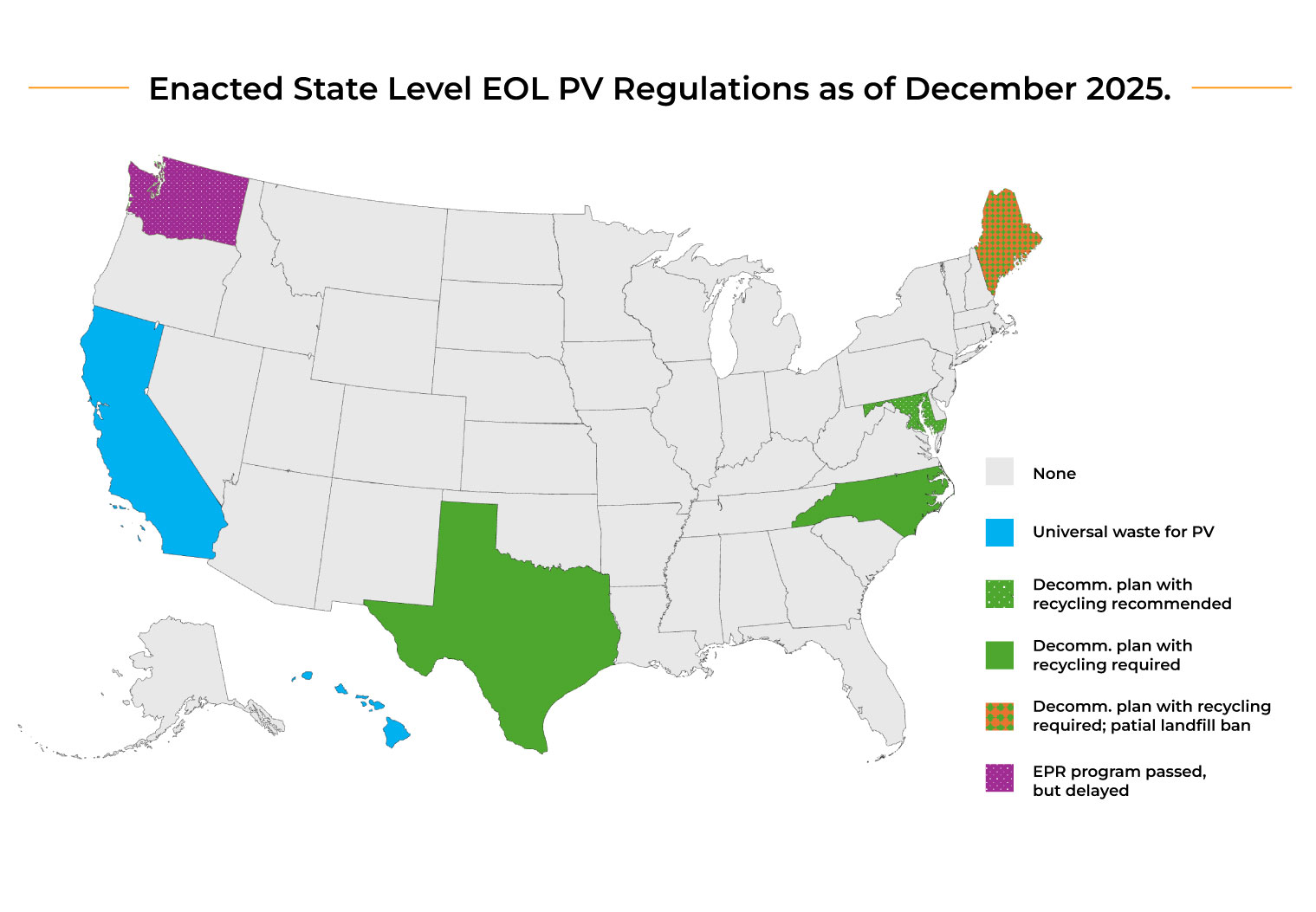
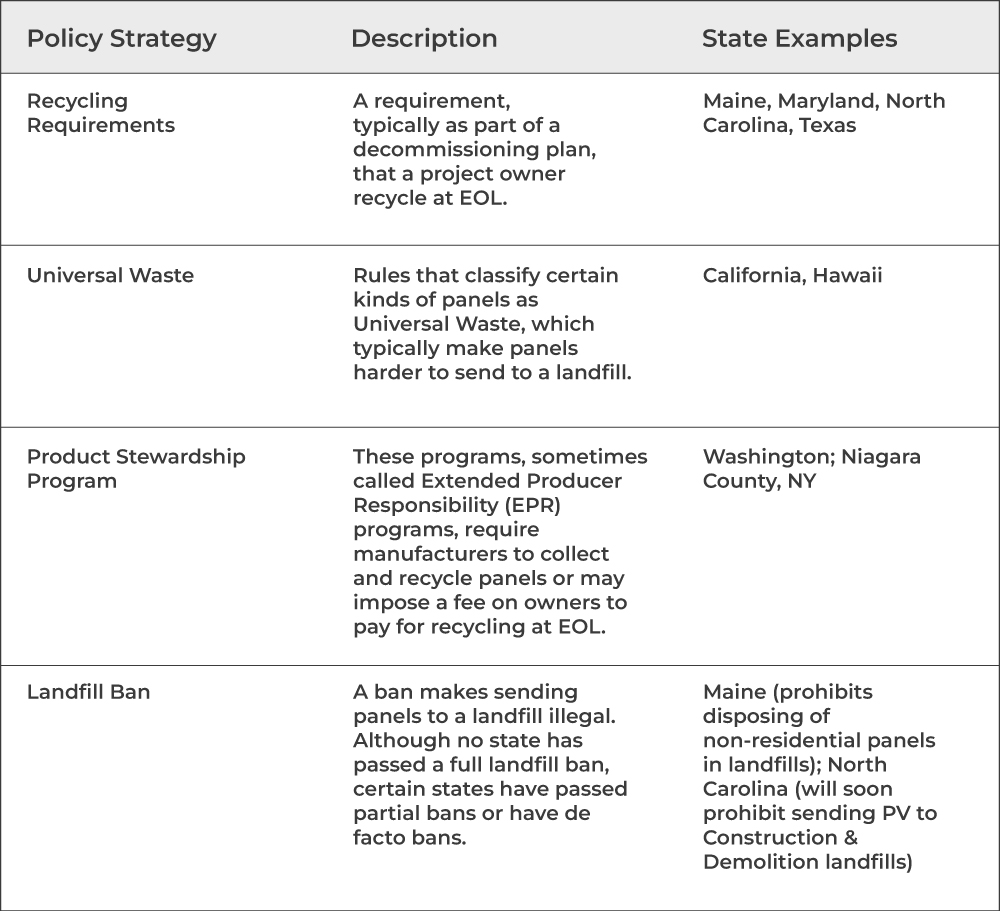
Four of those 33 states have added requirements to decommissioning plans that require or recommend that renewable power projects recycle their equipment at EOL. Maine, Maryland (via Public Service Commission rules) and North Carolina now require or recommend recycling as part of a solar decommissioning plan — and Texas, a giant in the solar industry, has just passed a new law, HB 3229, that adds this requirement to new projects in the state.
From a nuts-and-bolts perspective, this type of policy is easy to implement, especially if a state has existing decommissioning rules. The language in North Carolina’s House Bill 130 (2023) provides a straightforward approach: When a utility-scale solar project is decommissioned, the owner must remove the equipment, restore the site, and then reuse or recycle all the equipment that is capable of being recycled.
Our take is that adding recycling requirements to decommissioning plans is the best approach in most states because it provides a clear signal to encourage circularity, allows asset owners to budget for recycling and fosters competition to keep costs low. The downside of this kind of policy is that it typically doesn’t cover smaller projects, and it doesn’t cover projects that are already in operation. Expensive financial assurance requirements can also make projects more expensive than they need to be — especially because it’s hard to forecast the cost of recycling several decades out.
Of the 33 states with some kind of decommissioning policy, 29 of those states also require solar projects to provide some kind of financial assurance, which means that project owners have to put up a bond, note or cash to pay the estimated costs of decommissioning when they are ready to retire the project.
One way to keep the cost of decommissioning plans low is to allow asset owners to use a graduated approach that takes a page from how Minnesota’s PUC handles wind decommissioning. This approach, suggested by Adam Sokolski of EDF power solutions during the Minnesota Policy Working Group on solar recycling, requires owners to provide financial assurance for about 10% of the expected decommissioning costs during construction. As the project matures, owners must increase coverage until the full decommissioning costs are assured before the project’s expected end. This accentuates the benefits of decommissioning plans, while keeping costs low and ensuring that projects have the funds to decommission and recycle modules as the project progresses.
A Universal Waste (UW) designation for EOL solar is another strategy that’s being used to regulate solar and could help promote recycling. UW is a type of hazardous waste designation reserved for common, low-risk wastes, that is meant to streamline the management of the waste. California and Hawaii have both implemented rules that classify certain kinds of decommissioned panels as UW and a few years ago the U.S. EPA opened a federal rule making, which is still in progress.
Categorizing panels as UW will create some pressure to recycle and makes decommissioning panels easier for asset owners, but it can also make it harder and more expensive to recycle the panels at EOL. Because of this, SOLARCYCLE supports efforts to categorize panels as UW when appropriate, but only if these rules also simplify the requirements for the legitimate recycling of UW panels at EOL.
Landfill bans or restrictions are another tool that some states are turning to. Although there are no state-wide bans on solar disposal in landfills, Maine and North Carolina have passed partial restrictions on the disposal of solar and California, due to its UW rules, has a de facto ban on in-state disposal. Several other states have introduced bans in the past few years, although none of these laws have passed.
While a simple way to promote recycling, we’re not in favor of landfill bans because they retroactively create burdens on operating projects and because they could just cause the burden of disposal to shift to another state or location.
The last type of policy that states are exploring is a Product Stewardship program, sometimes known as an Extended Producer Responsibility (EPR) program. These types of programs are the most complex to administer and have been difficult to implement in the U.S., especially at the state or local level. Only Washington State has passed a state-level EPR for solar, but they’ve had to delay the implementation several times and the program is now due to go into effect in January of 2031.
There’s one other solar-specific EPR in the U.S., which is in Niagara County, New York. Known as Local Law 4, the Niagara County EPR is interesting in that it allows both equipment manufacturers and asset owners to submit recycling plans. Looking at the County’s most recent compliance summary, we can see that uptake by manufacturers has been slow with only one approved plan and one plan pending approval — but the site-specific plans have worked better with 6 projects submitting plans.
Because EPRs are policy strategy that is being used in various states to manage things like used electronics and paint, many state legislators have introduced bills to set up these kinds of systems in recent years. Arizona, California, Connecticut, Massachusetts, Minesota, New York, New Jersey, Illinois have all introduced EPR-style bills in the past two years that cover solar panels — although none of these bills have passed as of yet.
Although a national EPR might make sense if it was designed properly, we oppose state and local EPRs as they drive up the cost of new projects, are complex to administer both for state agencies and the solar industry, and they are a relatively inflexible and hard to adapt as solar technology changes.
The table below summarizes the four main policy strategies being used in the U.S. to regulate solar at EOL.
Our recommendation is that states start by adding recycling requirements to their decommissioning laws. Since the majority of states have some type of decommissioning law on the books, adding a recycling requirement will cover the large systems and create the volumes that recyclers need to continue to innovate and drive down costs.
Although decommissioning plans typically only cover larger projects, they are a good starting point for state policy. The sooner states pass these kinds of laws, the sooner asset owners and developers can price in recycling. For states that do want to take action, SOLARCYCLE has developed a set of Policy Guidelines, below.
As states work on policy strategies, solar asset owners, manufacturers, EPCs and other players in the solar industry should continue to explore public-private partnerships and voluntary actions. When large buyers of clean energy, such as Microsoft — an investor in SOLARCYCLE — require their solar developers to recycle at EOL, this sends a positive signal to the industry at large.
The trends are becoming clear: recycling technology is improving, and costs are dropping — so any policy efforts should support the recycling that’s already happening. If we align public policies with industry efforts, we can get more developers to commit to recycling, accelerate the use of recycled materials in new projects, and create the circular flows that will make recycling both cheaper and easier than throwing valuable materials into a landfill.
