


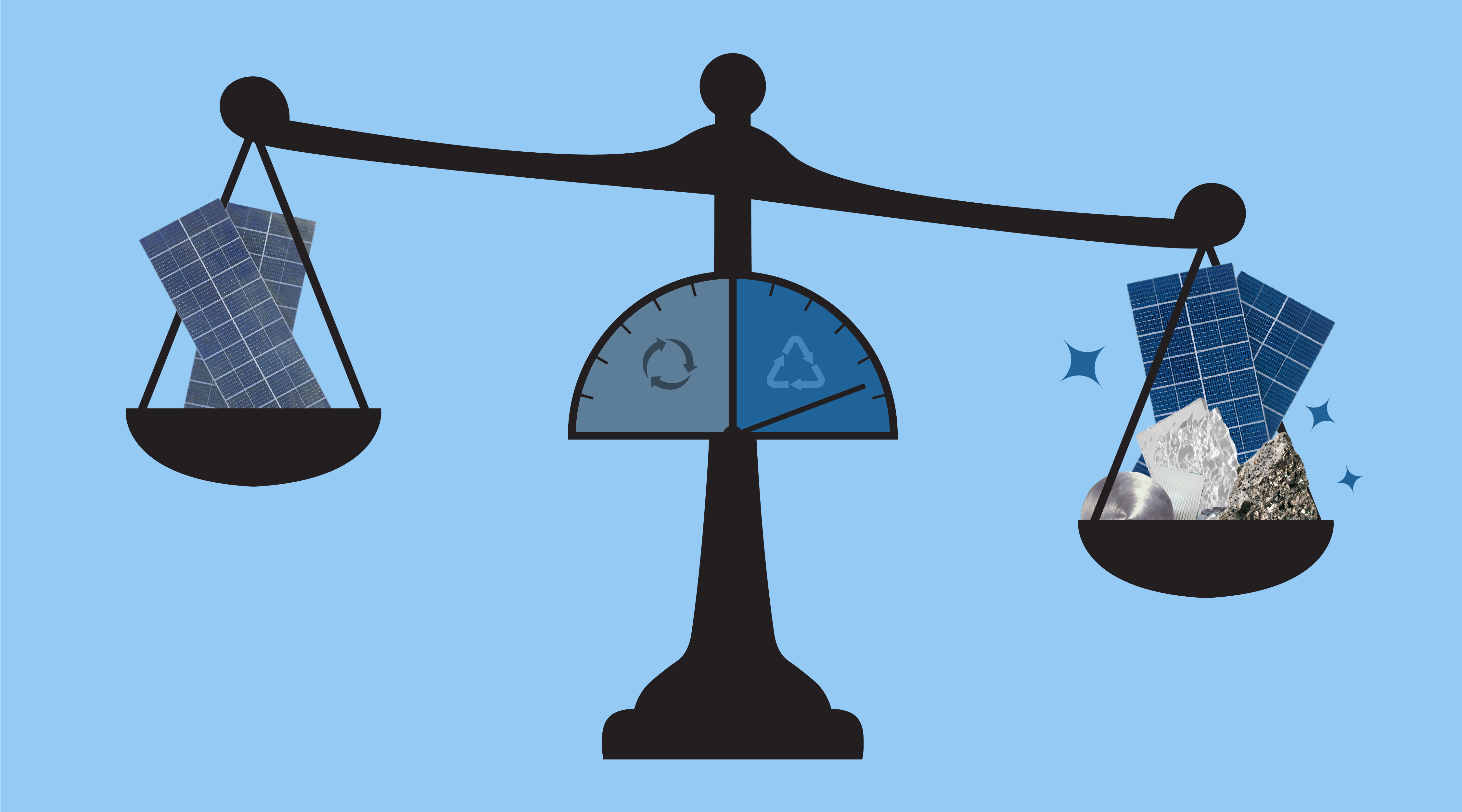
Reuse first, then recycle. When it comes to retired solar panels, most of us in the solar industry agree it’s what should be done, but those of us doing it know that it’s not straightforward. There are numerous arguments for why reuse just doesn’t work in most real-world scenarios.
But even when conditions are ideal, does solar panel reuse create the sustainable reality we want to live in? We conducted a thought experiment to evaluate the climate impacts of solar circularity vs solar panel reuse. The results surprised us.
From an emissions perspective, solar is unlike almost every other waste stream because a solar panel is not inert (e.g., clothing, plastic packaging, concrete and steel beams from a demolition site). As long as it's connected to a grid, a solar panel produces carbon-free electricity. That means there's a real carbon opportunity cost associated with not putting a working panel back to work.
By that logic, when it comes to climate impact, reuse should always win over recycling. A reused panel keeps producing clean energy year after year. A recycled panel delivers a one-time benefit: the emissions avoided by not mining and refining virgin materials. One is continuous, the other is finite.
Case closed?
Here's the wrinkle. Solar is also unusual in how fast the technology evolves. Every year, manufacturers create modules that make more power out of fewer energy-intensive materials, produced more efficiently. This trend even has a name: consumption per power, or CPP. Meanwhile, an individual panel is warrantied for 25 or 30 years.
So, there's a mismatch. Panels are built to last decades physically, but they fall behind technologically in a fraction of that time. These mismatches are where exceptions to rules tend to hide.
Which led us to a sharper question. For a panel that has already been decommissioned, can recycling enable a more climate-friendly outcome than reuse, if we can close the loop and the recovered materials go into a new, better panel?
We used life cycle assessment (LCA) to compare two futures for the same retired panel: a 375 Wp monofacial crystalline silicon module, which is the average of the panels in our own 500 kW second-life array.
Then we looked for what we're calling the carbon overtake moment: the point at which the new panel has generated enough clean electricity to cover its own life cycle emissions and surpass the electricity the reused panel produced over that same stretch of time.
Ten months.
That's how long it takes the new 600 Wp panel to overtake the reused one. Even at the most conservative end of our sensitivity range – a 400 Wp replacement carrying the highest material intensities we modeled – overtake arrives within six years.
Every scenario we ran lands well inside a standard 25-to-30-year manufacturer warranty. Under the conditions we modeled, overtake isn't a question of if. It's a question of when.
This study is theoretical and has undeniable limits.
We assumed reuse at scale with no friction, i.e., no condition, demand, or regulatory barriers, and none of the social and ethical complications of an unregulated reuse market. That gives reuse the strongest possible case, and it still gets overtaken.
We measured one impact category: climate change, or global warming potential. It's the metric that lets us compare our data against outside data honestly, but it is not the whole environmental picture nor an economic one.
It’s also true that no one has yet recycled a retired panel all the way back into a new one. This is a thought experiment about a system we're still building.
We've defined a set of conditions under which recycling can outperform reuse on climate: advanced recycling at scale, a connected secondary supply chain, and low-carbon domestic manufacturing that can actually take recycled material back.
With end-of-life panel waste projected to reach 54 to 160 million metric tons by 2050, the time to build those conditions is before the waste arrives, not after. Solarcycle has already demonstrated closed-loop manufacturing is technologically feasible for solar glass. We're working on scale.
The waste hierarchy taught us to reuse before we recycle. The solar industry has redefined a lot over the past few decades, and this rule of thumb may be the next to fall.
Our analysis drew on SOLARCYCLE's primary operations data and panel composition data, and NREL (NLR)'s LCA data for modern module manufacturing, assuming all activity occurs in the U.S. in 2024. Full methodology is in the white paper.
